










Govern your Microsoft Fabric estate with Collibra
Share on:


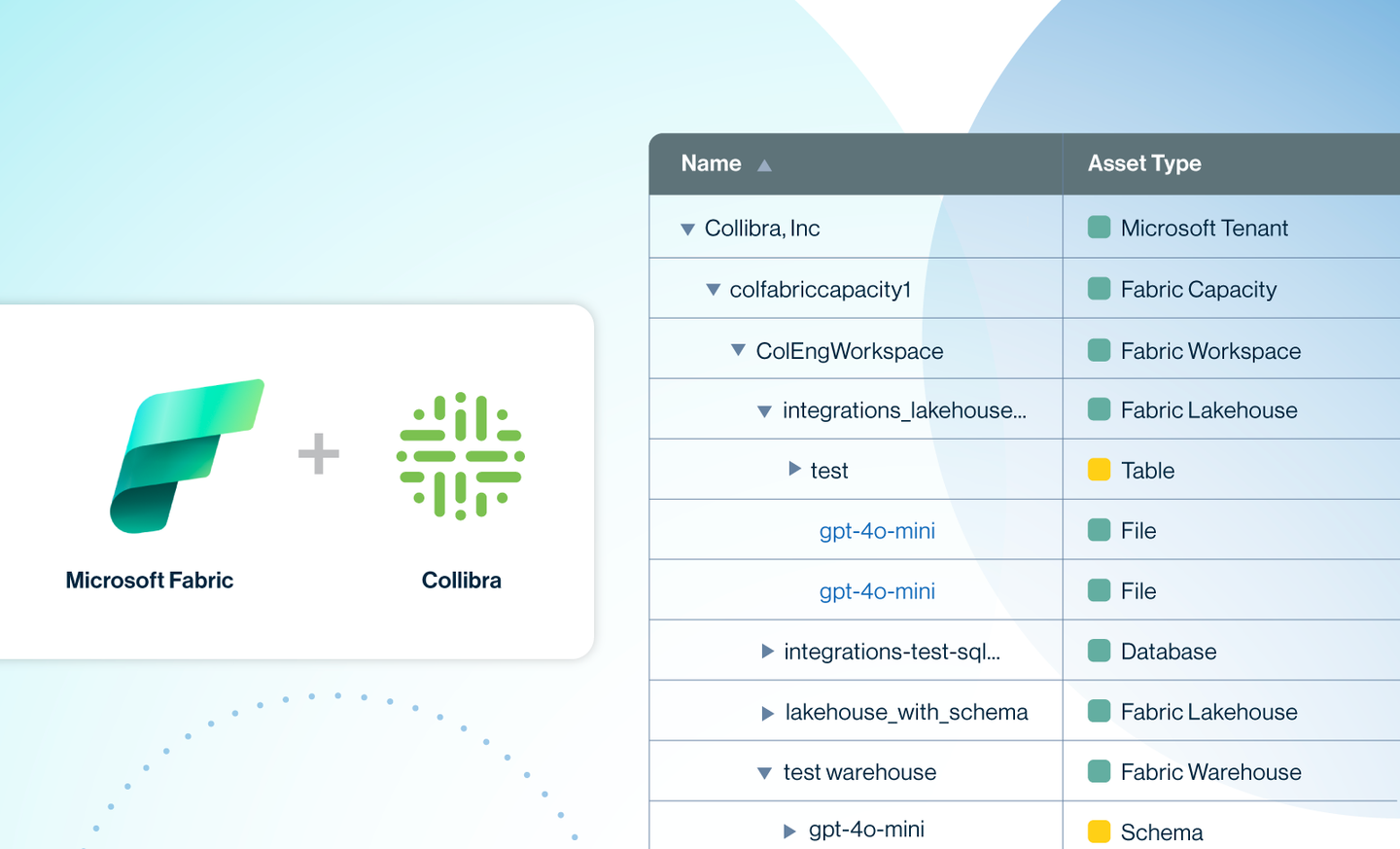
Enterprises are adopting Microsoft Fabric at remarkable speed — more than 28,000 organizations now build analytics on the platform. But few run Fabric in isolation; it sits alongside cloud warehouses, operational databases and dozens of other sources. Trusted data and confident AI depend on governing all of it by the same standards, not one platform at a time. The opportunity is to extend the governance you already rely on across your entire ecosystem — Fabric included.
What’s new: Microsoft Fabric Integration
Today, we’re excited to announce that our new integration connects Microsoft Fabric directly to the Collibra Platform, automatically ingesting metadata into your catalog and knowledge graph. Rather than forcing teams to document Fabric data by hand or move it into yet another tool, the integration harvests technical metadata where it already lives and represents it as fully governed assets in Collibra.
The integration spans the core data stores that power a modern Fabric estate: SQL Server, Fabric data lakehouses and Fabric data warehouses. Each source is mapped to Collibra's metamodel, so databases, schemas, tables, views, columns, files, warehouses and lakehouses appear as structured, related assets — ready for stewardship, classification and policy enforcement. The result is a single, trusted view of your Fabric data alongside every other source in your ecosystem, governed consistently regardless of where the data lives or which engine processes it.
How the Microsoft Fabric integration helps
As organizations standardize on Fabric, the volume of data flowing through lakehouses, warehouses, and SQL Server grows faster than any team can manually document. That scale creates blind spots: undocumented tables, unclear ownership and data whose meaning and sensitivity no one can confirm. Our integration with Microsoft Fabric closes that gap by continuously synchronizing Fabric metadata into Collibra, so every asset is discoverable, classified and governed by the same policies that apply across your ecosystem. Stewards spend less time cataloging and more time curating, while the business gains a trusted, consistent view of its Fabric data.
Our integration with Fabric solves problems:
- Agent-ready context: Gives AI agents governed, related and classified Fabric data to reason over instead of a flat, ungoverned object list, so they can infer business meaning and act reliably, rather than retrieving blindly and hallucinating.
- Metadata silos: Frees Fabric metadata from inside the platform and unifies it with every other source in Collibra, so governance is never limited to one engine or environment.
- Manual cataloging burden: Automatically harvests databases, schemas, tables, views, columns, files, and lakehouses, eliminating the error-prone work of documenting Fabric assets by hand.
- Hard-to-navigate data: Ingests Fabric assets with their structural relationships intact — columns roll up to tables, tables to schemas, and schemas to databases, lakehouses or warehouses — so teams can understand and explore the estate instead of facing a flat list of objects.
- Fragmented governance across engines: Applies one consistent set of policies and standards to Fabric data and the rest of the ecosystem, regardless of source or compute engine.
How the Microsoft Fabric integration works
The integration is configured in Collibra by registering Microsoft Fabric as a source. You provide the connection details for your Fabric environment and select the items you want to bring under governance. From there, Collibra harvests the technical metadata automatically — no manual export, and no need to move or copy the underlying data.
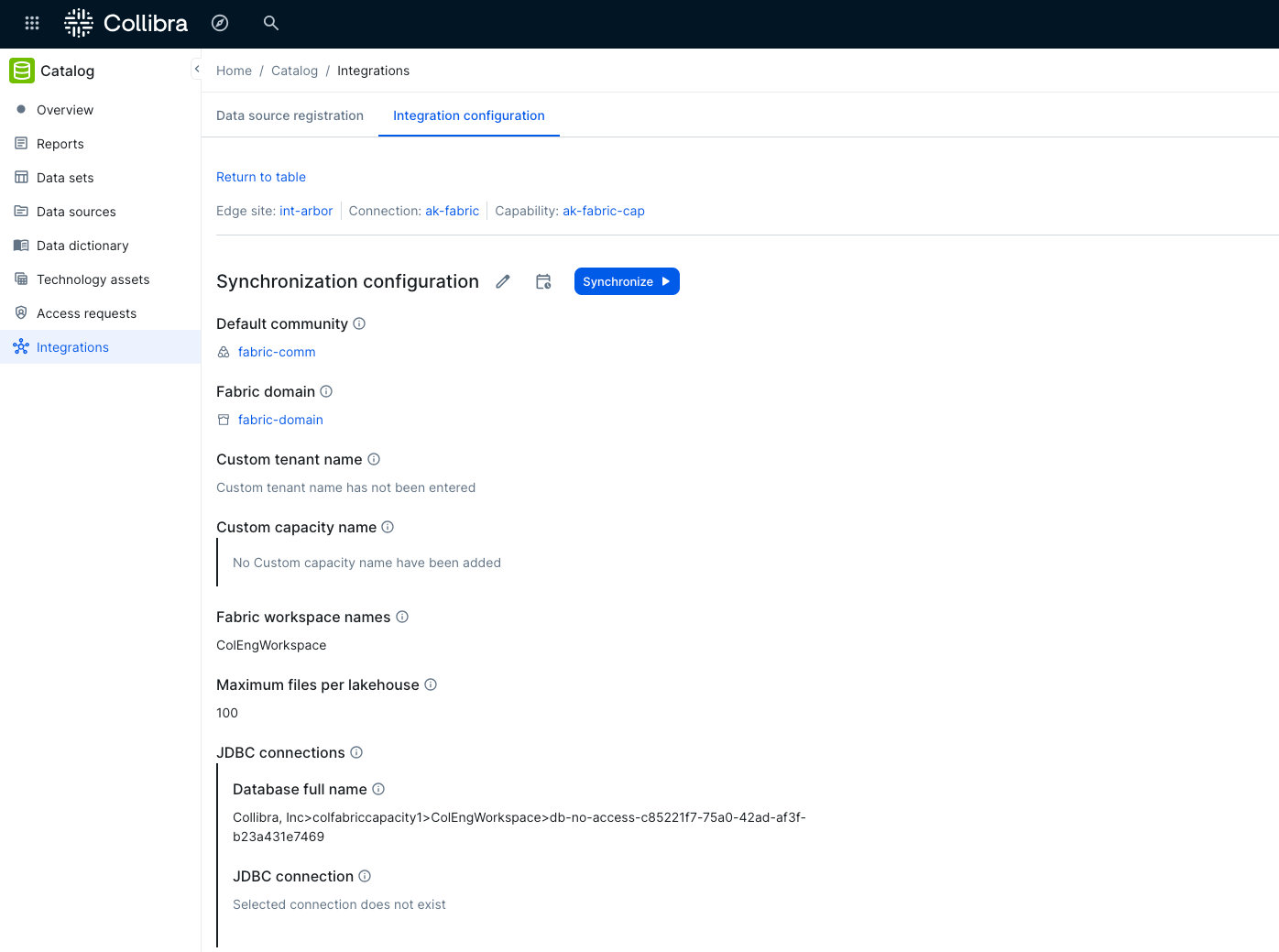
Configure synchronization settings for Microsoft Fabric integration directly in Collibra's Catalog.
The integration supports three Fabric source types, each mapped to the Collibra metamodel so that ingested metadata appears as structured, related assets:
- SQL Server — resulting assets represent databases, schemas, tables and columns.
- Fabric data lakehouse — resulting assets represent data lakehouses, files and tables.
- Fabric data warehouse — resulting assets represent data warehouses, schemas, tables, views and columns.
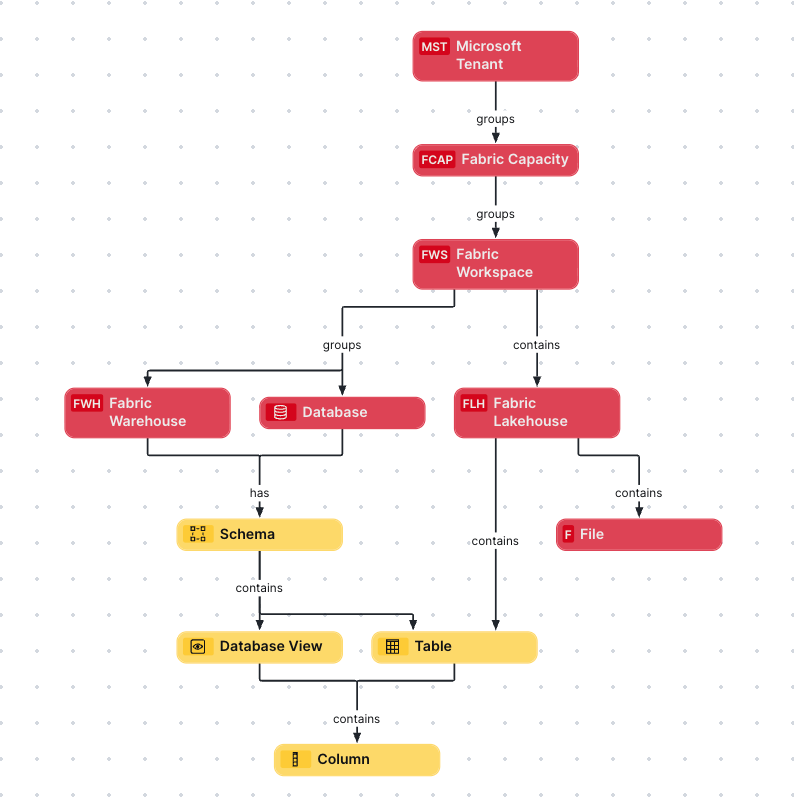
The Microsoft Fabric metamodel in Collibra — how SQL Server, lakehouse and warehouse metadata map to governed asset types.
Once a source is registered, metadata runs on scheduled synchronization cycles, keeping your catalog current as Fabric evolves. Each harvested asset is ingested into the knowledge graph with its relationships intact, so a column rolls up to its table, a table to its schema and a schema to its database, lakehouse or warehouse. Users can browse, search and steward these Fabric assets exactly as they would any other source in Collibra.
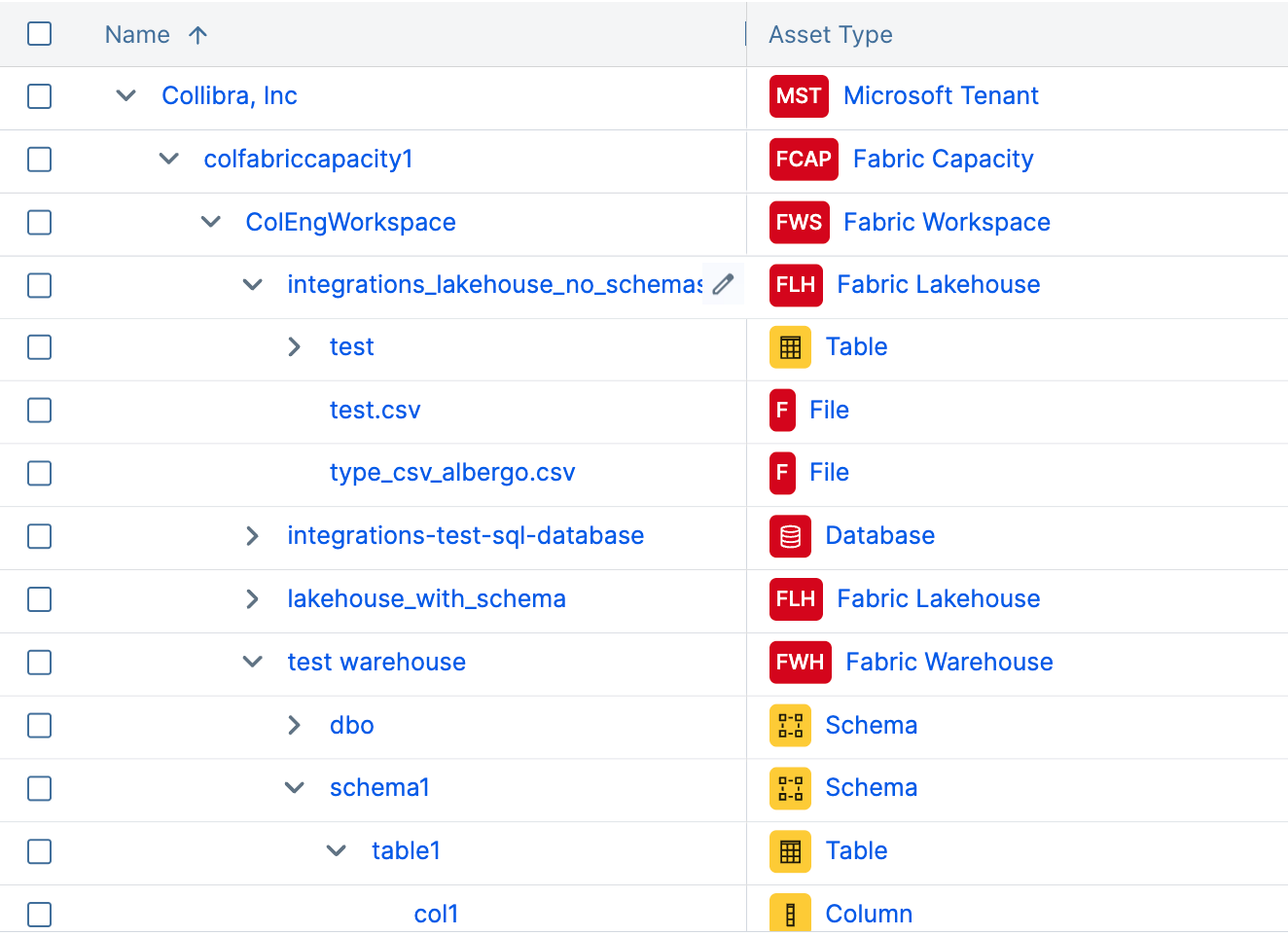
Browse and search harvested Fabric assets in the Collibra catalog, with full structure and relationships preserved.
Because Fabric metadata now lives in the knowledge graph, it inherits the full power of the Collibra Platform. Teams can apply automated classification to flag sensitive data, attach data quality results and enforce governance policies and AI controls — all from the same place they govern every other source. The integration turns Fabric from a standalone analytics platform into a fully governed, trusted part of your wider data ecosystem.
Why you should be excited
By bringing Fabric metadata under unified governance, the integration delivers distinct value to the key roles responsible for trusted data:
- Data stewards: Skip the manual documentation work — Fabric assets arrive in the catalog ready to curate, classify, and enrich with business context.
- Data engineers and architects: Work from a clear, structured map of Fabric databases, schemas, tables, views, and columns, so they understand what exists across the estate and can design with confidence.
- Data governance managers: Gain a single, consistent view of how Fabric data is governed alongside every other source, with the same policies applied everywhere.
- Compliance and risk teams: Surface and classify sensitive data inside Fabric and demonstrate that it meets policy and regulatory requirements.
Use cases
- Fast onboarding of new Fabric sources: Register a Fabric warehouse, lakehouse or SQL Server source and let Collibra harvest its metadata automatically, so new assets appear in the catalog as governed, owned and classified — without manual documentation or copying data.
- Self-service discovery of trusted Fabric data: Catalog lakehouse files, tables and warehouse views so analysts and AI teams can find and understand the data they need, complete with context and ownership, instead of rebuilding pipelines on data they can't verify.
- Compliance and AI readiness at scale: Classify and govern sensitive data across SQL Server, lakehouses and warehouses, then enforce consistent policies — for example, confirming that data used to train or feed AI models is correctly classified and free of restricted information.
Key takeaways about the Microsoft Fabric integration
The Microsoft Fabric integration with the Collibra Platform brings the metadata from your fastest-growing analytics platform into Collibra automatically, without moving the underlying data. By mapping SQL Server, lakehouse, and warehouse metadata to the knowledge graph, it makes Fabric data discoverable, classified and governed by the same policies you apply everywhere else. The result is one trusted view of your entire ecosystem — Fabric included — so teams can find data faster, prove compliance and move AI initiatives forward with confidence.
Where to learn more about the Microsoft Fabric integration
Get started with our product documentation: About the Microsoft Fabric integration.

Varun Reddy
Varun Reddy
Principal Product Manager
Collibra

Meredith Bailey
Meredith Bailey
Senior Product Marketing Manager
Collibra

Andrei Yerameyeu
Andrei Yerameyeu
Software Engineer
Collibra
Share on:
Keep up with the latest from Collibra
I would like to get updates about the latest Collibra content, events and more.
Thanks for signing up
You'll begin receiving educational materials and invitations to network with our community soon.